| En Français | Home/Contact | Billiards | Hydraulic ram | HNS | Relativity | Botany | Music | Ornitho | Meteo | Help |
This document offers a three-part reading of religions: their most widely shared points of convergence, a revealing point of divergence - the human condition, and a personal key to interpretation - the life laws, which reinterprets these different points without claiming to represent a religious consensus.
The points found, in one form or another, in most of the world's major religious traditions, are as follows [CLA][PER][CHA] :
1. A dimension of the sacred :
A reality that transcends the ordinary world, whether one or several gods, an impersonal force, a principle, or a state of awakening.
2. Founding narratives and texts :
Sources explaining the origin of the world, of humanity, and often the meaning of existence.
3. A morality :
Almost all religions offer a morality : do not kill, do not steal, do not lie, help the weakest - often summed up in a "golden rule" inviting one to treat others as one would wish to be treated.
It is often part of a broader cosmic order in which actions have consequences (divine judgment, karma, Tao, rita), and calls for respect for others, compassion, and selfless love.
4. Practices :
Ritual acts structuring religious life : prayers, meditation, chanting, sacrifices, fasting, pilgrimages, offerings, rites of passage (birth, marriage, death).
5. A community :
A group of believers who share a faith, practices, and traditions, and pass them on.
6. A response to suffering and death :
Religions often offer an explanation and a framework for making sense of suffering and human finitude, and often propose a form of hope beyond death (reincarnation, paradise, union with the divine, etc.).
7. A path of personal transformation :
The idea that human beings can progress toward a better state (purification, salvation, awakening, liberation, illumination, wisdom, etc.) through varied paths suited to different temperaments (knowledge, devotion, selfless action, meditation, ascetic discipline), all tending toward inner peace.
8. Sacred places, objects, and times :
Churches, synagogues, temples, mosques, ritual objects, religious festivals.
While many religions converge on the idea of an ordinary human state marked by agitation and a lack of peace, they differ widely on the nature of this state, the goal to be reached, and the path to get there.
- Modern esoteric movements (notably Gurdjieff [OPD 1][OPD 2]) view the human condition as a state of incompleteness and psychological sleep dominated by automatism. Nature develops the human being up to a certain point, then leaves them free to pursue - or not - their evolution through a conscious work of transformation leading to a higher state of consciousness and real will.
- Indian traditions (Hinduism, Buddhism, Jainism, Sikhism) see it as a state of bondage (karma) born of attachment, subject to the laws of difference, change, and causality. They aim for liberation from the cycle of rebirth (moksha, nirvana, kevala, mukti) through knowledge (jnana), devotion (bhakti), selfless action (karma-yoga), meditation (dhyana, of which Zen is the Buddhist formulation), or ascetic discipline (tapas).
- Taoism sees it as a departure from the harmony of the Tao, caused by agitation, desire, and artifice. It aims at a reintegration into this harmony through non-action (wuwei, absence of forced or artificial action) and natural spontaneity (ziran).
- Confucianism, arising from the same Chinese cultural and religious context, views the human condition as a fundamentally perfectible state, characterized by seeds of virtue : benevolence (ren), righteousness (yi), propriety (li), wisdom (zhi). It aims for their full flourishing through the study and practice of rites, within family, social, and political relationships.
- Monotheistic religions (Judaism, Christianity, Islam and Baha'i faith) see it as a disobedience to God or an estrangement from God. They aim for a salvation that combines, depending on the tradition, human effort, moral education, and assistance of divine grace.
- Zoroastrianism, one of the oldest monotheistic traditions, sees the human being as taking part in a cosmic struggle between good and evil. Each person contributes through their choices - their thoughts, words, and actions - until the final victory of good.
- Polytheistic and animistic religions, notably Shintoism and certain African religious traditions, follow a more ritualistic and collective logic. They aim to maintain or restore a balance with a multiplicity of spirits, ancestors, or natural forces, achieved through rites, offerings, and respect for sacred prohibitions.
Religions can also be viewed according to how they position human beings in relation to a dimension that transcends them [CLA][PER][CHA] :
- Submission to a higher reality. Human beings submit to the will or commandments of a reality that transcends them. Mainly : Monotheistic religions.
- Participation in a higher reality. Human beings actively contribute, on a cosmic scale, to the fulfillment of an order that transcends them. Mainly : Zoroastrianism.
- Adjustment to a higher reality or to an ethical dimension. The human being preserves or restores, within their immediate environment and on an ongoing basis, a balance with the surrounding powers or harmony in social relationships. Mainly : Polytheistic and animistic religions, Confucianism.
- Inner transformation. Human beings transform their state of consciousness in order to access a deeper reality and and become one with it. Mainly : Modern esoteric currents, Indian traditions, Taoism.
Beyond the points of convergence, it is possible to propose a spiritual reading that runs through all of them : that of the "laws of life".
The first three - difference, change, causality - describe the world as religions offer it to be lived concretely : a diversity of forms (point 1), narratives (point 2), practices (point 4), communities (point 5), and places (point 8), set within time and within a cosmic order in which actions have consequences (point 3). The law of change sheds particular light on the question of suffering and death (point 6).
The fourth law - unity without a second - corresponds to the horizon toward which several traditions orient the path of personal transformation (point 7) : a peace that no longer depends on difference, change, or causality.
This reading is, however, one proposal among others, characteristic in particular of non-dualist currents, such as Vedanta or certain Buddhist schools. It is not shared by theologies that maintain a strict distinction between Creator and creature, such as Judaism, Christianity, or Islam in their majority currents.
A small number of truth seekers, notably Svâmi Prajnânpad, have simply described the laws of life as follows (from the book [Petit Régis, Une approche scientifique du silence]).
* Svâmi Prajnânpad, the truth, emotion / feeling, to think / to see
Svâmi Prajnânpad (alias Svâmiji, 1891-1974) was a Bengali Brahmin who had received dual training, classical Vedantic and modern scientific trainings.
A master of wisdom and lucidity, his rigorous approach is a dive into the heart of the unconscious which reveals the difficulties hindering the silence of mental. No God, no ritual, no paradise.
André Comte-Sponville said about him : "This master is content to see, to be one with what he indifferently calls truth or reality, which is neutral, neither good nor bad, neither pleasant nor painful, and promised only change or death." [PDS 2]
According to the specific vocabulary of his teaching [EHM 1] :
* Inner peace, truth, science
* Ego, attachment, mental, identification
* Thought, emotion, desire
* To be
* Spirituality





[ARI 1] Association pour le Rayonnement Culturel Indien, Citation de Mata Amritanandamayi, La Lettre N 3 de l'ARCI, 2ème trimestre 1987
[BTC 1] Bouchet Christian, Gurdjieff - qui suis-je, Pardès 2001
[CHA] ChatGPT, le moteur d'Intelligence Artificielle développé par OpenAI.
[CLA] Claude, le moteur d'Intelligence Artificielle développé par Anthropic.
[CSA 1] Comte-Sponville André, De l'autre côté du désespoir - Introduction à la pensée de Svâmi Prajnânpad, Accarias-L'Originel 1997
[CSO 1] Cambessédès Olivier, Le quotidien avec un maître Svami Prajnanpad, Accarias L'Originel 1995
[DAF 1] Desjardins Arnaud et Farcet Gilles, Confidences impersonnelles, Critérion 1991
[DAF 2] Desjardins Arnaud et Farcet Gilles, Regards sages sur un monde fou, La Table Ronde 1997
[DAL 3] Desjardins Arnaud et Loiseleur-Desjardins Véronique, La voie et ses pièges, La Table Ronde 1992
[DAL 4] Desjardins Arnaud et Loiseleur-Desjardins Véronique, L'ami spirituel, La Table Ronde 1996
[DEA 1] Delaye Alain, Sagesses concordantes - Quatre maîtres pour notre temps : Etty Hillesum, Vilama Thakar, Svâmi Prajnânpad, Krishnamurti, Volume I, Accarias-L'Originel 2003, 2011
[DSA 7] Desjardins Arnaud, A la recherche du Soi 1 - Adhyatma yoga, La Table Ronde 1977
[DSA 8] Desjardins Arnaud, A la recherche du Soi 2 - Le vedanta et l'inconscient, La Table Ronde 1978
[DSA 9] Desjardins Arnaud, A la recherche du Soi 3 - Au-delà du moi, La Table Ronde 1979
[DSA 10] Desjardins Arnaud, A la recherche du Soi 4 - Tu es cela, La Table Ronde 1980
[DSA 15] Desjardins Arnaud, La voie du coeur, La Table Ronde 1987
[DSA 17] Desjardins Arnaud, Zen et Vedanta - Commentaire du Sin sin ming, La Table Ronde 1995
[DSA 19] Desjardins Arnaud, Retour à l'essentiel, La Table Ronde 2002
[DSA 21] Desjardins Arnaud, Bienvenue sur la voie, La Table Ronde 2005
[DSA 23] Desjardins Arnaud, Lettres à une jeune disciple, La Table Ronde 2006
[DSD 1] Desjardins Denise, De naissance en naissance, La Table Ronde 1977
[DSD 3] Desjardins Denise, Mère sainte et courtisane, La Table Ronde 1983
[DSD 7] Desjardins Denise, La route et le chemin - Carnet de voyage et d'ascèse, La Table Ronde 1995
[DSD 9] Desjardins Denise, Conteurs, Saints et Sages - Des Pères du désert à Swâmi Prajnânpad, La Table Ronde 1998
[DSD 10] Desjardins Denise, Petit traité de l'action, La Table Ronde 1999
[EHM 1] Edelmann Eric, Humbert Olivier et Dr Massin Christophe, Swâmi Prajnânpad et les lyings, La Table Ronde 2000
[FTG 1] Farcet Gilles, Arnaud Desjardins ou l'aventure de la sagesse, La Table Ronde 1987
[FTG 3] Farcet Gilles, La transmission selon Arnaud Desjardins, Le Relié 2009
[GKG 1] Guéshé Kelsang Gyatso, Vivre une vie pleine de sens - Mourir dans la joie, Tharpa France 2017
[GKG 2] Guéshé Kelsang Gyatso, Transformez votre vie. Un voyage plein de félicité, Tharpa France 2009
[LRF 1] Leboyer Frédérick, Portrait d'un homme remarquable - Svami Prajnanpad, Critérion 1991
[LRV 1] Loiseleur-Desjardins Véronique, Anthologie de la non dualité, La Table Ronde 1981
[MAM 1] Mâ Ananda Moyî, L'enseignement de Mâ Ananda Moyî, traduit par Josette Herbert, Albin Michel 1974
[MRD 1] Marol et Roumanoff Daniel, Sois sage, La Table Ronde 1994
[NIL 1] Nduwumwami Louis, Krishnamurti et l'éducation, Du Rocher 1991
[OPD 1] Ouspensky Petr Demianovitch, L'homme et son évolution possible, Denoël 1961 puis Accarias L'Originel 1999
[OPD 2] Ouspensky Petr Demianovitch, Fragments d'un enseignement inconnu, Stock 1974
[PDS 1] Prajnanpad Svami, L'art de voir, Lettres à ses disciples - Tome 1, Traduction de Colette et Daniel Roumanoff, Accarias-L'Originel 1988
[PDS 2] Prajnanpad Svami, Les yeux ouverts, Lettres à ses disciples - Tome 2, Traduction de Colette et Daniel Roumanoff, Accarias-L'Originel 1989
[PDS 3] Prajnanpad Svami, La vérité du bonheur, Lettres à ses disciples - Tome 3, Traduction de Colette et Daniel Roumanoff, Accarias L'Originel 1990
[PDS 4] Prajnanpad Svami, A B C d'une sagesse, Paroles choisies par Daniel Roumanoff, La Table Ronde 1998 puis Albin Michel 2009
[PDS 5] Prajnanpad Svami, L'éternel présent - Questions et réponses - Entretiens avec Pierre Wack, Traduction de Daniel Roumanoff, Accarias-L'Originel 2002
[PDS 6] Prajnanpad Svami, Les formules de Swâmi Prajnânpad commentées par Arnaud Desjardins, Formules et commentaires rassemblés par Véronique Desjardins, La Table Ronde 2003
[PDS 7] Prajnanpad Svami, Le but de la vie - Un été plein de sagesse, Entretiens avec Roland de QuatreBarbes été 1966, traduits par Daniel Roumanoff, Accarias-L'Originel 2005
[PDS 8] Prajnanpad Svami, Svâmi Prajnânpad pris au mot - Les Aphorismes, Recueillis et traduits par Frédérick Leboyer, Accarias-L'Originel 2006
[PDS 9] Prajnanpad Svami, Ceci Ici A présent - Seule et unique réalité, Entretiens avec Frédérick Leboyer (première série, janvier et février 1963), Traduction de Colette et Daniel Roumanoff, Accarias-L'Originel 2006
[PDS 10] Prajnanpad Svami, La connaissance de soi - Citations commentées des Upanishad et histoires (tome 1), Mises en forme par Daniel Roumanoff, Accarias-L'Originel 2008
[PER] Perplexity, le moteur d'Intelligence Artificielle développé par Perplexity AI.
[PSP 1] Prakash Sumangal et Prajnanpad Svami, L'expérience de l'unité, Traduction de Colette et Daniel Roumanoff, Accarias-L'Originel 1986 puis 2013
[RFD 1] Roumanoff Daniel, Svâmi Prajnânpad - Tome 1 Un maître contemporain - Manque et plénitude, La Table Ronde 1989, puis regroupé avec le Tome 3 chez Albin Michel 2009 sous le titre "Tome 1 Les lois de la vie"
[RFD 2] Roumanoff Daniel, Svâmi Prajnânpad - Tome 2 Le quotidien illuminé, La Table Ronde 1990, puis Albin Michel 2009
[RFD 3] Roumanoff Daniel, Svâmi Prajnânpad - Tome 3 Une synthèse Orient Occident, La Table Ronde 1991, puis regroupé avec le Tome 1 chez Albin Michel 2009 sous le titre "Tome 1 Les lois de la vie"
[RFD 4] Roumanoff Daniel, Candide au pays des Gourous - Journal d'un explorateur de l'Inde spirituelle, Dervy 1990
[RFD 5] Roumanoff Daniel, Svâmi Prajnânpad - Biographie, La Table Ronde 1993
[RFD 6] Roumanoff Daniel, Psychanalyse et sagesse orientale - Une lecture indienne de l'inconscient, Accarias L'Originel 1996
[SNR 1] Srinivasan Ramanuja, Entretiens avec Svami Prajnanpad, Traduction de Colette Roumanoff, Accarias-L'Originel 1984
This chapter explores the different facets of hypnosis, including its side effects and potential dangers, the world of show hypnosis, self-hypnosis techniques, as well as the legal and ethical aspects that govern its use.

E2.1. Definition :
Hypnosis is an ancient technique dating back more than 6000 years in the Orient and to the end of the 18th century for modern hypnosis. It produces a modified state of consciousness located between wakefulness and sleep.
More precisely, it allows to induce by speech a particular state of consciousness characterized by indifference to the outside and a greatly increased capacity to receive suggestions (in particular the voice of the hypnotist) [ANM][INS][ MAB].
At the psychological level, hypnosis induces a state of deep relaxation based on freely given suggestion [AFI].
At the neurological level, hypnosis involves a change in brain activity, including a decrease in activity in regions associated with processing sensory information and an increase in activity in regions associated with attention and suggestion [MAB].
Hypnosis is used in different medical sectors [MIN] :
- anesthesia (hypnosedation), to reduce the stress of the operation, or even allow certain operations without resorting to general anesthesia, which is replaced by a sedative medication and quality local anesthesia ;
- pain management (hypnoanalgesia), particularly in obstetrics to reduce labor pain ;
- psychotherapeutics (hypnotherapy), to help people achieve a state of deep relaxation allowing them to work on their problems (fear, stress, blockage, etc.) without causing unwanted side effects.
E2.2. Side effects :
Side effects of hypnosis are as follows :
- Temporary and mild effects : headaches, fears, sadness, disorientation, etc. [CFH1][MAB]
- Rare but serious effects : hallucinations, altered memories, personality change, depression, suicidal impulses, etc. [CFH1]
These side effects are not always the consequence of hypnosis as such. They may arise due to the pre-existing vulnerability of the subject, the practitioner's inexperience in dealing with psychotherapeutic problems, the use of inappropriate suggestions, the inability to erase non-therapeutic suggestions or to fully redirect the patient through adequate debriefing [CFH1].
These reactions occur more often in certain contexts such as show hypnosis, or when the training and experience of the practitioner are insufficient [CFH1].
E2.3. Dangers :
The dangers of hypnosis are as follows :
- Incompetent or clumsy hypnotist : he can in particular plunge a person back into a past trauma without knowing how to manage the situation [ATK].
- Absence of prior diagnosis : a practitioner who does not know how to use the hypnosis tool without prior clinical, psychological or somatic knowledge, will not be able to distinguish between the psychological expression of a serious pathology and a disorder that may be sensitive to a hypnotic approach. Thus, anxiety can be a sign of a pulmonary embolism, a myocardial infarction and many other severe disorders. It is therefore appropriate for the practitioner who is going to use hypnosis to be able to have explored all the possible causes of the disorder, or failing that, to have verified with the patient's treating physician that the pathology has been explored and diagnosed or that the psychosomatic origin has been demonstrated [CFH1].
- Non-compliance with medical contraindications : hypnosis should not be practiced on people with heart disease, epilepsy or serious psychopathology (delusions, psychosis, paranoia, etc.) [CFH1][MAB].
- False memories : the unconscious can produce coherent but false responses, often in an attempt to relieve suffering. Hypnosis accentuates this phenomenon [CFH3][BEN].
Any practitioner must refuse any patient request aimed at rediscovering forgotten memories [CFH3] or verifying the reality of a memory (for example, women who believe they were abused as children) [BEN].
- Poor management of emotional reactions after hypnosis, which can lead to persistent discomfort [CFH1][UNI][ATK].
E2.4. Show hypnosis :
Show (or street or fair) hypnosis is a hypnosis technique close to therapeutic hypnosis, practiced for commercial or occult purposes which has nothing to do with the patient's interest [ATK].
Unlike therapeutic hypnosis, the show hypnotist does not establish rapport with the subject, adopt an authoritative and directive approach, do not debrief individually and do not interrupt the hypnotic trance if necessary [CFH2].
The individual on stage volunteered to play the game and showed particular skills in the trance state during the pre-test carried out by the hypnotist. Added to this is the group effect which reduces the unconscious resistance of the individual [UNI]. The show then consists of attracting the audience by producing spectacular reactions (for example, seeing a subject think he is a chicken on a wall) [GRO].
Many people hypnotized on stage say that, although they are aware of being ridiculed, they paid to go on stage, people watch them and they have an astonishing experience [SAR].
Show hypnosis presents dangers that therapeutic hypnosis does not have: dangers in particular for people with with heart disease, epilepsy, serious pathology or psychologically fragile [CFH1][MAB]. Added to this is the non-management of possible emotional reactions upon exiting hypnosis [CFH1][UNI][ATK].
E2.5. Self-hypnosis :
Self-hypnosis is hypnosis practiced alone, without the help of a practitioner. Like meditation, self-hypnosis is a physical and mental relaxation technique. But unlike meditation :
- The purpose is therapeutic (resolution of a problem) and not spiritual (search for inner peace).
- Relaxation involves an active suggestion or visualization (and not a simple caring attention to the experience of the moment) aimed at achieving a specific objective, such as stress management or improving self-confidence.
- Awareness of the external world disappears in favor of an internal look, while in meditation consciousness is both internal (thoughts, emotions, sensations) and external (perceptions of the environment). The person being hypnotized feels like they are dissociated, with one part of them observing what the other part of themselves is doing, while the meditator is aware of everything that is happening in and around them [PIC].
E2.6. Legal framework :
In France, there is no legal framework to regulate the practice of hypnosis. There is only teaching of hypnosis at the university, associative and private level, as well as various ethical codes of hypnosis.
Two types of hypnosis practices can be distinguished [SEN] :
- Therapeutic hypnosis is practiced by health professionals in the medical field (doctors, psychiatrists, psychotherapists and clinical psychologists) and paramedical field (dentists, midwives, nurses, physiotherapists, occupational therapists and psychomotor therapists).
- Hypnosis known as "better being" is practiced by other professionals under various names : hypnotherapist, hypnopractitioner, hypnologist, hypnosis psychopractitioner, brief therapy practitioner, etc. They must not use certain reserved words such as : "psychotherapist", "patient", "consultation", "diagnosis", "prescription", under penalty of "illegal practice of medicine". We therefore do not speak of "patient" but of "client".
In France the exercise of therapeutic hypnosis in a context other than medical is similar to the illegal exercise of medicine (No. 09-81.778 of the Criminal Chamber of March 9, 2010, and article L.4161-1 of the public health code) [SEN][CFH4].
E2.7. Ethics of hypnosis :
The Confederation Francophone Hypnosis and Brief Therapies (CFHTB) published in 2003 an ethical code of hypnosis based on medical ethics, the principles of which are as follows [CFH4] :
1. The best interests and well-being of the patient are the highest priority.
2. Hypnosis is considered a complement to other forms of clinical or supportive scientific practices.
3. The hypno-practitioner will limit his scientific or supporting clinical use of hypnosis to the areas of competence recognized by the regulations of his profession or the uses relating to it.
4. The hypno-practitioner undertakes not to use hypnosis or brief therapy as a form of distraction or spectacle.
5. In all cases, the transition to the practice of hypnosis will remain conditional on obtaining a complete qualification in the professional field considered.
6. The communication of information relating to hypnosis to the various media is accepted to the extent that it is based on precise scientific knowledge.
E2.8. Sources relating to hypnosis :
[AFI] AFIS, L'hypnose : charlatanisme ou avancée médicale ?.
[ANM] Académie nationale de médecine, Thérapies complémentaires - acupuncture, hypnose,
ostéopathie, tai-chi - leur place parmi les ressources de soins, rapport de la séance du 5 mars 2013.
[ATK] Jean-Marc Atkins, Quels sont les dangers de l'hypnose (ericksonienne) ?
[BEN] Jean-Marc Benhaiem, L'hypnose ne permet pas de retrouver la mémoire de faits réels..., Huffpost
[CFH1] CFHTB, Confédération Francophone Hypnose et Thérapies Brèves, Risques et dangers de l'hypnose
[CFH2] CFHTB, Confédération Francophone Hypnose et Thérapies Brèves, Risques et dangers de l'hypnose : hypnose de spectacle
[CFH3] CFHTB, Confédération Francophone Hypnose et Thérapies Brèves, Risques et dangers de l'hypnose : les faux-souvenirs
[CFH4] CFHTB, Confédération Francophone Hypnose et Thérapies Brèves, Livre blanc de l'hypnose clinique et thérapeutique
[FTB] I2FTB, Quel cadre légal quand on fait de l'hypnose ou PNL ?
[GRO] Laurent Gross, EMDR, Hypnose ericksonienne, médicale et thérapeutique à Paris
[IFH] IFH, Institut Français d'Hypnose, Lexique en hypnose thérapeutique
[INS] Inserm, Evaluation de l'efficacité de la pratique de l'hypnose - 2015
[MAB] Emmanuel Mabin, e-academy.fr, Mieux comprendre l'hypnose
[MIN] Ministère de la Santé et de la Prévention
[PIC] Caroline Pico, Similitudes et différences entre hypnose et méditation
[SAR] Corinne Sarazin, Les dangers de l'hypnose eriksonienne ou autre
[SEN] Sénat, Réponse du Ministère des solidarités et de la santé publiée le 14/02/2019
[UNI] Unitheque, Quels sont les métiers de l'hypnose ?
Smell and taste are the two senses that aroused the least interest from scientific researchers until the 1960s.
Today, we know that the sensory perception of smells and flavors is a subtle mix between universal principles, personal perception and culture.
E3.1. Smells
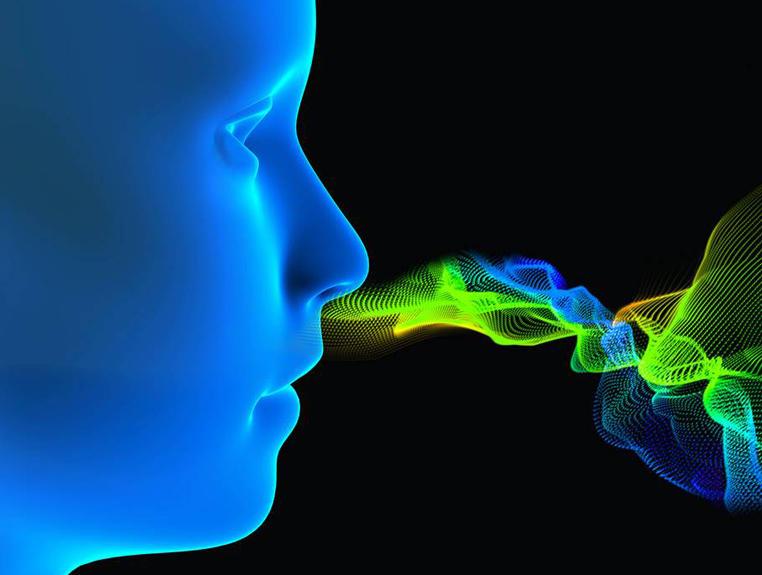
Smells are molecules detected chemically by olfactory receptors located in the nasal cavity.
They can take two distinct routes : a direct route, called orthonasal, located in the nose (concept of "smell") or an indirect route, called retro-nasal, located in the back of the throat (concept of "aroma" released by food in the mouth).
There is to date no universal consensus on the categorization of smells. Only perfumery and oenology have produced specific classifications.
The table below allows you to simply categorize smells according to their effects (unpleasant/pleasant) and their origins (mineral, plant, animal, human).
Sources relating to smells :
Claude Boisson, "La dénomination des odeurs : variations et régularités linguistiques", Intellectica, 1997/1, 24, pp. 29-49.
Sophie David, Danièle Dubois, Catherine Rouby, Benoist Schaal, "L'expression des odeurs en français : analyse lexicale et représentation cognitive", Intellectica, 1997/1, 24, pp. 51-83.
Dico du Vin, Odeurs du vin, nouvelle classification, Dico-du-Vin 2023.
Danièle Dubois, "Des catégories d'odorants à la sémantique des odeurs", Terrain, 47 | 2006, 89-106.
Camille Gaubert, 03.05.2022, "Notre perception des odeurs n'est que très peu liée à notre culture", Cerveau et Psy.
André Holley, "Le physiologiste et la catégorisation des odeurs", Intellectica, 1997/1, 24, pp. 21-27.
L'Atelier du Vin, Guide des arômes du vin et de leur perception en oenologie.
Hervé-Pierre Lambert, "L'imaginaire, les neurosciences et l'olfactif : confirmations et extrapolations", IRIS, 33 | 2012, 37-51.
C. Sulmont-Rossé, I. Urdapilleta, "De la mise en mots des odeurs", chapitre 28 (pp. 373-382) du livre : Odorat et Goût : de la neurobiologie des sens chimiques aux applications agronomiques, industrielles et médicales, Edition QUAE.
Luc a Poyo Vallina, 24 nov. 2022, "Les 10 principales odeurs perçues par l'odorat humain", Divain, .
Wikipedia, Rétro-olfaction.
E3.2. Flavors
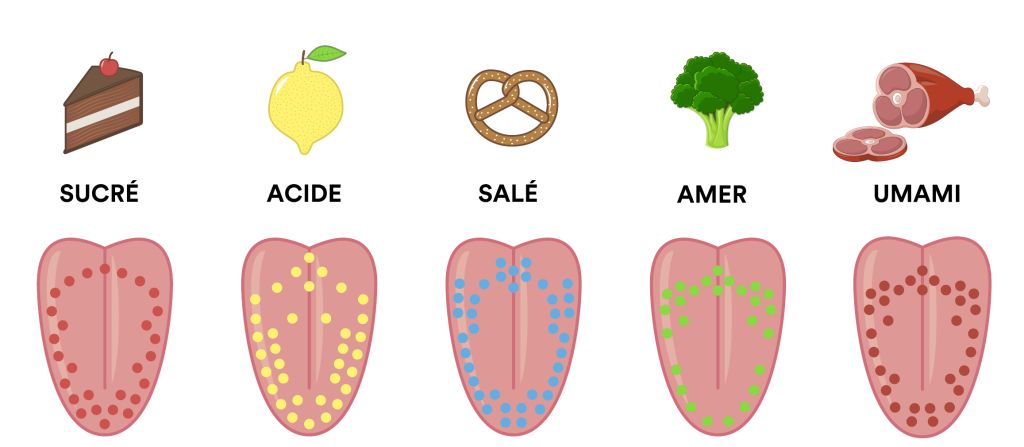
Flavors are molecules detected chemically by taste receptors located on the taste buds of the tongue.
Other sensations in the mouth, also called "flavors" in the broad sense, do not involve the taste buds and are sensory (olfactory, auditory, visual) and somesthetic (thermal, tactile, proprioceptive (position and movement) and nociceptive (pain)).
The table below describes the basic flavors, "flavors" being taken in the broad sense. They can then combine with each other to form more elaborate taste sensations.
Sources relating to flavors :
Le Thi Maï Allafort, Connaissez-vous les mots du goût ? Lorsque les textures font le plaisir !, Marie Claire.
Christine Belloir, Récepteurs gustatifs humains : étude des relations structure-fonction, Thèse 2019, Université de Bourgogne.
Diane Boivineau, Evaluation gnoso-praxique linguale des enfants avec trouble structurel du langage oral, Mémoire 2013/2014, Université Paris VI.
Loïc Briand, "La chimie du goût", CultureSciences-Chimie.
Juliette Defossez, Vers un langage du goût : approche expérimentale d'une communication multimodale à destination des mangeurs, Thèse 2014, Université de Bourgogne.
Audrey Dufour, 24/01/2017, "Comment reconnaît-on les saveurs ?", La Croix.
Goûts et Papilles, C'est quoi le goût ? Odeur, saveur, flaveur....
FasterCapital, Au-delà du goût : comment la texture influence notre perception des aliments.
Claire Gresser, Contribution à l'étude de la composante trigéminale dans la posture cervico-faciale, Thèse 2005, Université de Lorraine.
Tanya Lewis, 5 octobre 2021, "Ce que les piments peuvent nous apprendre sur la douleur", Pour la Science.
Christophe Otte, Olivier Otte, Régulation des dysfonctions maxillo-faciales de l'enfant, Clinique OPS.
Dale Purves, George J. Augustine, David Fitzpatrick, Lawrence C. Katz, Anthony-Samuel LaMantia, James O. McNamara, Neurosciences - Les sens chimiques, DeBoeck
Rapport du groupe PNNS - Qualité gustative des aliments et environnement des repas : restauration scolaire, hospitalière et aide alimentaire, décembre 2010.
Si on me coupait la langue, pourrais-je toujours savourer mes repas ?, La sensation trigéminale.
Wikipedia, Goût.
Wikipedia, Thermorécepteur.
E4.1. Introduction :
Genetics is the science that studies the organization, functioning, regulation and modification of genes, both in their transmission from one generation to another and in their expression within the same individual.
It includes six major scientific fields [PER][CHA] :
1. Genome organization and cell manufacturing
Each cell in the human body contains a complete copy of the organism's genetic material (the genome), carried by DNA (Deoxyribonucleic Acid).
This genome contains all the instructions necessary to produce all of the body's proteins. However, in practice, each cell expresses only a portion of the genes, depending on its specialization. For example, a muscle cell will produce mainly contractile proteins, and few or no proteins specific to neurons or immune cells.
Proteins play an essential role in the body. On the one hand, they perform structural functions by maintaining and repairing tissues. On the other hand, they act as regulators of vital functions, notably participating in genetic regulation (histones and transcription factors), hormonal regulation (hormones), digestive regulation (enzymes), oxygen transport in the blood (hemoglobin), and immune defense (antibodies).
Each cell thus produces two main types of proteins :
- Effector (or target) proteins, such as structural proteins, transport proteins, hormones, enzymes, that perform the body's cellular and physiological functions.
- Regulatory proteins, such as histones and transcription factors, that control gene expression.
Once produced, proteins are transported to their sites of action (cells, organs, tissues). Some, like hormones, travel through the blood to reach distant organs.
2. Genetic Regulation
Genetic regulation is the control of gene expression, particularly through modulation of DNA accessibility, without modifying the DNA sequence.
The main players in this mechanism are :
- Non-coding DNA sequences (not translated into proteins), which consist mainly of Non-coding genes and Intergenic sequences.
- Regulatory proteins, which are of two main types : Histones ensuring the compaction of the DNA around them and therefore the modulation of its accessibility, and Transcription factors which bind to non-coding DNA sequences to activate or repress gene expression.
- Epigenetic modifications, which are reversible additions of chemical groups to DNA molecules and also to histone tails, altering DNA accessibility and therefore the body's response to internal and external stimuli.
- Long non-coding RNAs, which act as indirect regulators, for example, guiding proteins to specific regions of DNA.
3. Genetic Variation
Genetic variation is the production of genetic differences. The main mechanisms are as follows :
- Mutation : Lasting modification of the DNA sequence at the gene, chromosome, or entire genome level.
- Recombination (crossing-over) : Exchange of DNA segments between homologous chromosomes during meiosis, creating new genetic combinations.
- Polymorphism : Coexistence of several normal genetic forms in a population, as demonstrated by the ABO blood group system in humans, which produces a diversity of groups (A, B, AB, O, etc.).
- Transposition : Change in the position of a DNA segment within the genome.
- Genetic drift : Random change in the frequencies of different forms of a gene in a small population, often due to chance events (catastrophes, isolation) that reduce the number of individuals.
- Migration (or gene flow) : movement of individuals from one population to another, resulting in the arrival or departure of certain gene forms in the host population.
- Random mating : reproduction where partners are chosen at random, promoting genetic mixing within the population.
4. Genetic Repair
Genetic repair is the correction of errors or damage in DNA. The main mechanisms, classified by increasing severity of the damage, are as follows :
- Direct repair : For a slightly damaged base
- Base excision repair (BER) : For an absent or severely damaged base
- Copy error repair (MMR) : For an erroneous sequence following DNA replication
- Nucleotide excision repair (NER) : For a damaged sequence
- Single-strand break repair (SSB repair) : For a broken strand, with the intact second strand serving as a template
- Double-strand break repair (DSB repair) : For a broken double strand
5. Genetic Transmission
Genetic transmission is the transmission of hereditary information at the individual level (between cells of the same organism) or transgenerationally (from one generation to the next). The main mechanisms are as follows :
- Replication : Faithful copying of DNA before each cell division.
- Mitosis : Cell division of somatic (body) cells producing two identical daughter cells with the same number of chromosomes as the parent cell.
- Meiosis : Cell division of germ (reproductive) cells producing two gametes (egg and sperm), each containing half the number of chromosomes. This division does not fragment the genetic information but intelligently redistributes it between the gametes through shuffling and control mechanisms, allowing fertilization to reconstitute a complete and unique genetic heritage.
- Fertilization : Fusion of two gametes (egg and sperm) to form an egg cell (zygote) with a full chromosome number.
- Mendelian inheritance : Transmission of hereditary traits via genes located on nuclear chromosomes (therefore inherited from both parents), according to Mendel's laws.
- Non-Mendelian inheritance : Transmission of hereditary traits that do not follow Mendel's laws, either due to the location of genes outside the nuclear chromosomes (such as mitochondrial DNA inherited only from the mother, or chloroplast DNA), or due to specific mechanisms affecting nuclear genes (such as parental imprinting, incomplete dominance, dynamic mutation, sex-linkage).
- Epigenetic transmission : Transmission, at the individual or transgenerational level, of regulatory marks of gene expression, without modification of the DNA sequence.
6. Natural Selection
Natural selection is an evolutionary mechanism that sorts individuals according to their ability to survive and reproduce.
Given the hereditary variations between individuals, natural selection favors certain traits within this diversity : individuals carrying genetic characteristics that are advantageous for their survival and reproduction in a given environment produce more offspring.
This concept of natural selection evolved historically in four stages (illustrated by the giraffe) :
- Lamarck (inheritance of acquired traits, 1809) : The giraffe lengthens its neck to reach high leaves and passes this acquired trait on to its offspring.
- Darwin (natural selection, 1859) : In giraffes, those born with longer necks through random individual variation survive better and reproduce more, thus producing more offspring.
- Neo-Darwinism (modern genetics, Collective, 1930-1940) : In giraffes, those born with longer necks due to random genetic mutations (not environmentally driven) survive better and reproduce more, thus producing more offspring.
- Epigenetics (regulation of gene expression, Waddington, 1942) : In giraffes, in addition to random genetic mutations, difficulty reaching high leaves could alter the expression of genes involved in neck growth, without changing the DNA sequence. These epigenetic modifications could be temporarily passed on to their offspring.
In summary :
Cellular functioning, through its major functions (organization, production, regulation, variation, repair, transmission), subtly illustrates the dynamic balance between assimilation and accommodation, as described by Jean Piaget.
Like the intelligence of living organisms which constantly adjusts its patterns to integrate or transform experience, the cell assimilates most events according to its genetic and epigenetic programs. But it also knows how to accommodate, that is, adjust or remodel its mechanisms, in the face of novelty or disruption.
This adaptive balance, the driving force of cellular plasticity, provides, on a larger scale, the innovations that are influenced by natural selection.
E4.2. Cell description :
A hierarchical description of the eukaryotic cell (with nucleus) is given as follows [PER][CHA] :
Note : The number shown is relative to the adult human being.
Eukaryotic cell = Plasma membrane + Cytoplasm + Nucleus. Number = 37 trillion
|
| Plasma membrane = Envelope separating the interior and exterior of the cell.
|
| Cytoplasm = Cytosol + Organelles
| |
| | Cytosol = Aqueous medium containing ions, nutrients, and enzymes.
| |
| | Organelles = Free ribosomes + Endoplasmic reticulum + Mitochondria + Golgi apparatus + Lysosomes + Cytoskeleton
| | | Free ribosomes = synthesize proteins from messenger RNA. Number = 10 million
| | | Endoplasmic reticulum (ER) = Synthesizes lipids (smooth ER) and other proteins (rough ER, with attached Ribosomes).
| | | Mitochondria = Produce cellular energy (ATP) through cellular respiration. Contain their own DNA (mitochondrial genome). Number = 100 to 10,000 (according to cell type).
| | | Golgi apparatus = Sorts, packages and transports molecules (mainly proteins and lipids) to their final destination (internal or external to the cell).
| | | Lysosomes = Digest cellular waste. Number = 300 to 500
| | | Cytoskeleton = Maintains cell shape and participates in cell movement.
|
| Nucleus = Nuclear membrane + Nucleoplate + Chromatin + Nucleoli
| |
| | Nuclear membrane = Double envelope separating the interior and exterior of the nucleus.
| |
| | Nucleoplate = Gelatinous medium containing enzymes and ions.
| |
| | Chromatin = Nuclear genome + Regulatory proteins + Associated RNAs + Epigenetic modifications
| | |
| | | Nuclear genome = Set of Chromosomes. Number = 23 pairs of chromosomes.
| | | | Chromosome = Compacted DNA molecule (double helix consisting of two antiparallel strands of nucleotides) = Coding genes + Non-coding genes + Intergenic sequences
| | | | | Coding gene = DNA sequence containing the information necessary for protein synthesis. Number = 20,000 coding genes per nuclear genome.
| | | | | Non-coding gene = DNA sequence containing the information necessary primarily for functional RNA synthesis.
| | | | | Intergenic sequences = Non-coding DNA sequences located between two adjacent genes (coding or non-coding). They notably constitute the anchoring platforms for Regulatory proteins and also include a diversity of repeated sequences. Proportion = 90 % of the nuclear genome.
| | | | | Nucleotide = Phosphate group + Deoxyribose sugar + Nitrogenous base. Number = several million per chromosome
| | | | | | Nitrogenous base = Adenine (A), Thymine (T), Cytosine (C), or Guanine (G). Number = 3 billion pairs of nitrogenous bases per nuclear genome.
| | |
| | | Regulatory proteins = Histones + Transcription factors
| | | | Histones = Proteins that compact DNA around themselves and thus modulate its accessibility.
| | | | Transcription factors = Proteins that bind to non-coding DNA sequences to activate or repress gene expression.
| | |
| | | Associated RNAs = Main mediators of gene expression
| | | | Messenger RNA (mRNA) = Copies a coding Gene (the blueprint for protein production) and transports it to the Ribosomes.
| | | | Transfer RNA (tRNA) = Transports amino acids to the Ribosomes and positions them according to the provided blueprint.
| | | | Ribosomal RNA (rRNA) = Forms the backbone of the Ribosomes and assembles amino acids into protein chains according to the provided blueprint.
| | | | microRNA = blocks specific messenger RNA, preventing their translation and thus reducing the production of effector proteins.
| | | | Long non-coding RNA (IncRNA) = Indirect regulator, for example, guiding proteins to specific regions of DNA.
| | |
| | | Epigenetic modifications = Reversible additions of chemical groups to DNA molecules and histones, thus altering DNA accessibility.
| |
| | Nucleoli = Synthesize ribosomal RNAs. Number = 1 to 5
E4.3. Epigenetics :
Epigenetics constitutes a biological underpinning common to all acquisition-based learning (memory stabilization, brain plasticity, metabolic adaptations). It allows cells to encode lived experience through changes in gene expression without altering the DNA sequence, unlike genetic mutations.
This fundamental mechanism dynamically regulates gene expression according to the physiological or environmental context, thus allowing the organism to adapt effectively to internal and external stimuli, including :
- Climate variations (temperature, humidity)
- Dietary changes (deficiency, excess, nutritional quality)
- Habitat changes (urbanization, pollution, migration)
- Physiological stress (illness, intense exercise)
- Traumatic stress (emotional shock, violence)
This regulation is achieved through reversible chemical modifications, such as :
- DNA methylation, by adding methyl groups to the DNA.
- Modification of regulatory proteins (mainly histones) around which DNA is wrapped.
These modifications dynamically control access to genes and their expression levels, allowing their activation or repression without altering the underlying genetic content.
Two levels of plasticity are distinguished :
Individual plasticity : When stimuli are moderate or transient, the changes remain confined to somatic (body) cells and are not transmitted to subsequent generations.
For example :
- The Arctic fox changes its coat (white in winter and brown in summer). Fox cubs are born with a coat adapted to their season of birth, but their ability to change color then depends on environmental stimuli (study by Zimova M., Mills L.S., Nowak J.J., 2016).
- In humans, skin tanning in response to the sun is a temporary adaptation specific to each individual (study by Slominski A., 2004).
Transgenerational plasticity : When stimuli are intense or prolonged, the changes also affect germ cells (sperm and oocytes). These marks are then transmitted to offspring and influence their phenotypes (behavioral, physiological, and morphological traits) for one to three generations before fading.
For example :
- In water fleas (Daphnia), parental exposure to predator signals induces the development of morphological defenses (helmets or spikes) in the offspring, even if the young have never encountered a predator themselves (study by Tollrian R., 1995).
- Male mice exposed to prolonged cold give birth to offspring better adapted to low temperatures (study by Chan J.C., 2020).
- Male mice conditioned to fear an odor transmit a specific hypersensitivity to that odor to their offspring (study by Dias & Ressler, 2013).
- In humans, malnutrition before pregnancy in the mother or father can have a lasting effect on the child's health, even if the child subsequently grows up in a normal food environment (study by Gete DG., Waller M., Mishra GD., 2020).
In the case of cognitive learning, epigenetics is closely linked to brain plasticity (neural networks) at two complementary coding levels [MER] :
- A structural level : Learning modifies the strength and organization of synaptic connections between neurons, ensuring the storage and consolidation of acquired information (memory).
- A biological level : Learning induces epigenetic modifications in the genome of neuronal cells, which regulate the expression of genes involved in synaptic plasticity and stabilization of neuronal networks.
Warning : Despite the profound impact of intensive cognitive activity (such as musical practice) on brain plasticity and neuronal epigenetics, these changes remain strictly individual. To date, no hereditary mechanism, genetic or epigenetic, has been demonstrated to transmit these adaptations to offspring.
E4.4. RNA :
RNA (RiboNucleic Acid) is the dynamic relay between DNA and all cellular activities, ensuring the transmission, translation and regulation of genetic information within the cell.
All RNAs are synthesized by direct copying of DNA sequences (transcription) through the action of RNA polymerase, a special protein initially present in the cell and then produced by messenger RNA, like all other proteins.
Warning : No RNA is a protein. RNA polymerase, despite its name, is not an RNA but a protein (enzyme) that makes RNA.
A specific type of RNA, messenger RNA (mRNA), is a partial and targeted copy of genetic information, then transmitted to ribosomes (in the cell cytoplasm). Ribosomes then "read" this messenger RNA (coding RNA) as a blueprint for making (synthesizing) proteins.
Other types of RNA, known as non-coding RNA, do not contribute to protein production. They are functional and perform key regulatory functions, such as :
- Blocking specific messenger RNAs to prevent their translation (e.g., microRNAs), thereby reducing the production of effector proteins.
- Controlling access to DNA via epigenetic modifications (e.g., long non-coding RNAs), thereby modulating gene expression without altering the DNA sequence.
E4.5. Sources relative to genetics :
[CHA] ChatGPT, le moteur d'Intelligence Artificielle développé par OpenAI.
[MER] Karine Merienne, Anne-Laurence Boutillier, Régulations épigénétiques et plasticité cérébrale : vers de nouvelles thérapies dans les maladies neurodégénératives ?, 2016.
[PER] Perplexity, le moteur d'Intelligence Artificielle développé par Perplexity AI.
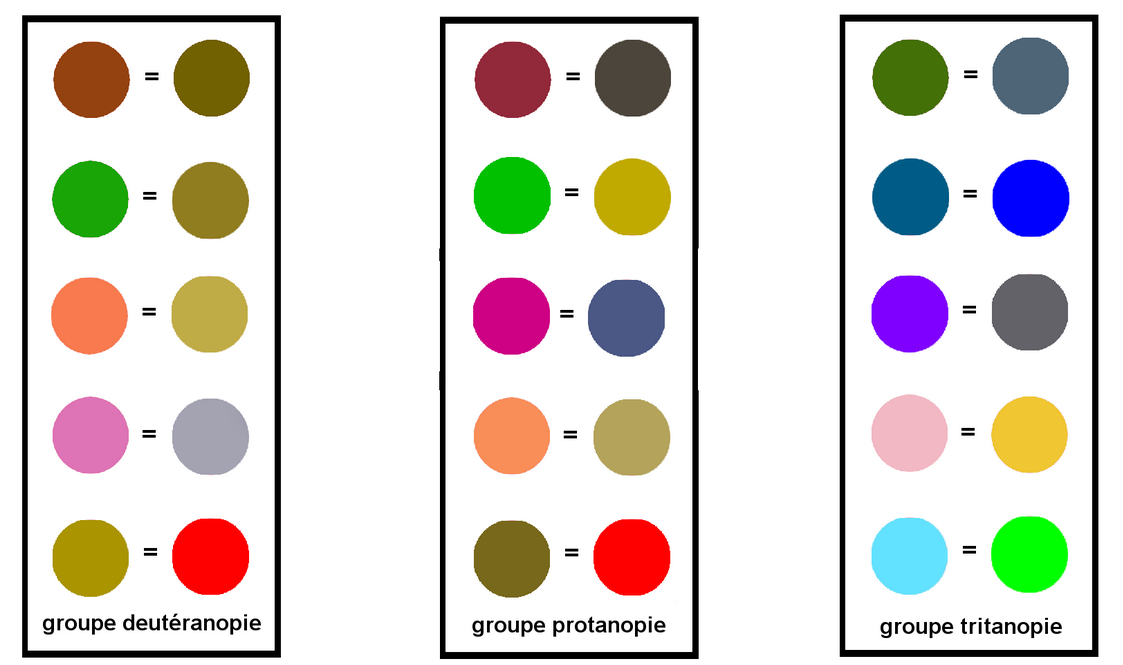
Figures 1, 2 and 3 above : Jean Jouannic's test n°7 (cf [OPT]) : The group showing two vertical alignments of similar colors indicates the type of color blindness (green, red, blue).
E6.1. Introduction :
Color blindness (or dyschromatopsia) refers to a disorder of color perception, most often of retinal origin.
The retina contains two types of light-sensitive cells. Rods provide grayscale vision, especially in low light. Cones provide color vision, primarily in bright light.
Cones are divided into three categories, each sensitive to a range of wavelengths roughly corresponding to green, red and blue.
In a color-blind person, one or more of these categories are absent or function abnormally, according to the following classifications :
- Green deficiency : deuteranopia (absence) or deuteranomaly (altered function),
- Red deficiency : protanopia (absence) or protanomaly (altered function),
- Blue deficiency : tritanopia (absence) or tritanomaly (altered function),
- Simultaneous deficiency of all three : achromatopsia.
In populations of European descent, about 8 % of men are affected by some form of color blindness, compared to only 0.5 % of women. Red-green confusion accounts for the vast majority of cases.
A little-known subtlety : spatial summation.
The accurate perception of a color does not depend solely on which cones are stimulated, but also on how many cones are activated at the same time. This is the principle of spatial summation.
When a colored surface is large and uniform, the cones send a stable signal. In a person with colour blindness, this signal is different but consistent, enabling the brain to associate it with a colour name, without reproducing the perception of so-called "normal" colour vision.
Thus, a color-blind person can easily distinguish a traffic light, a large colored area on a map, or a painted wall. The surface is large enough for the signal to be reliable.
What may escape them is a thin green line on a red background, a word written with a fine ballpoint pen, or the colored bands on electronic resistors. The stimulated area is too small, and the color blends into the background.
Another little-known aspect is the relationship to colour language.
For a person with colour blindness, the link between the colour perceived and its name is less reliable than for a person without colour blindness. Indeed, due to a lack of reliable and repeated visual associations - especially when the coloured area is small or gets lost in the background - the brain strengthens the link between visual perception and colour vocabulary less. It therefore relies more on other, more stable cues: context, shape, position, brightness, memory, etc., rather than on the colour itself and its name.
E6.2. Genetic cause :
Color blindness is most often of genetic origin. More rarely, it can be acquired during life as a result of certain ocular or neurological diseases, or from medications that affect the retina.
In hereditary cases [PER][CHA], color blindness results from anomalies in the genes that code for the pigments of the cones, most often those sensitive to green and red, and more rarely those sensitive to blue. In the most common forms (red or green deficiency), the genes involved are carried on the X chromosome.
Girls (XX), who inherit one X chromosome from each parent, express color blindness only if both X chromosomes carry the anomaly, which is rare. They can nevertheless carry the anomaly without being color-blind themselves, and pass it on to their children.
Boys (XY), who inherit an X chromosome from their mother and a Y chromosome from their father, are affected if they receive an X carrying the anomaly (a single copy is sufficient). This is why the condition is much more common in men than in women. A color-blind man therefore passes his affected X chromosome to all of his daughters, who become carriers of the anomaly, but to none of his sons, to whom he passes only his Y chromosome.
E6.3. Accessibility standards :
The World Wide Web Consortium Web Content Accessibility Guidelines (WCAG) are the global reference for the accessibility of websites and applications. For color blindness, four major rules apply :
- Use of color (Criterion 1.4.1 - Level A) :
Color must not be used as the only visual means of conveying information, indicating an action, prompting a response, or distinguishing a visual element. For example, a hyperlink should not be identified by blue color alone, but also by underlining. In charts, lines should be distinguished by shapes (dashes, symbols, etc.), not only by color.
- Text contrast (Criterion 1.4.3 - Level AA) :
For normal-sized text, the minimum required contrast ratio is 4.5:1. For large text, the required ratio is 3:1 (18-point text, or 14-point bold).
- Non-text contrast (Criterion 1.4.11 - Level AA) :
Essential graphical objects (such as thin lines and charts) must also meet a minimum contrast ratio of 3:1.
- Enhanced contrast (Criterion 1.4.6 - Level AAA) :
The required ratio increases to 7:1 for normal text and 4.5:1 for large text. In its official implementation guidance, WCAG recommends applying this rule to key graphical elements as well.
In addition to these standards, the Author of this site has produced a matrix of 24 safe contrasts selected from the 16 x 16 possible combinations of foreground and background colors defined in the HTML 4.01 standard. These 24 combinations are particularly well suited for people with green-deficient color vision.
E6.4. Sources relating to color blindness :
[CHA] ChatGPT, le moteur d'Intelligence Artificielle développé par OpenAI.
[OPT] Opticien-lentilles.com, Test n°7 (Jean Jouannic).
[PER] Perplexity, le moteur d'Intelligence Artificielle développé par Perplexity AI.
Two out of three people in France suffer from a visual disorder such as myopia, hyperopia, astigmatism, or presbyopia.
These disorders are generally caused by an abnormal eyeball length, an irregularly shaped cornea, or a loss of flexibility of the crystalline lens, preventing light rays from forming sharp images on the retina.
A normal eye is called emmetropic, whereas an eye with a refractive error is called ametropic.
E7.1. Eye anatomy :
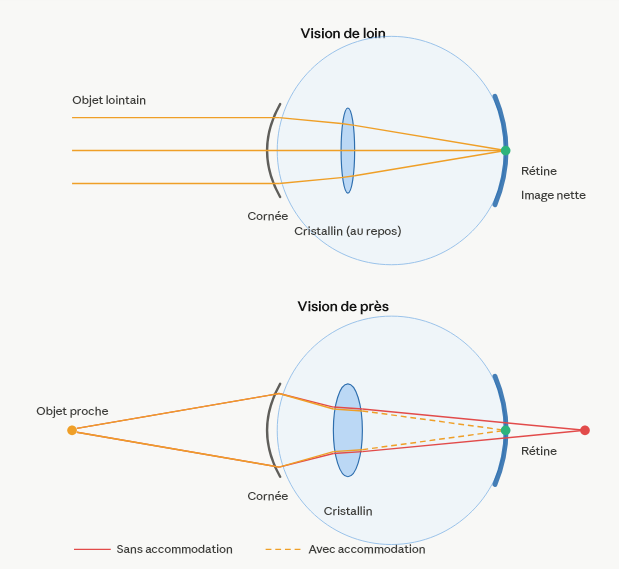
The eye can be compared to a camera (see Figure 1 above, cf. [CLA]). It consists of an eyeball that captures light and converts it into information transmitted to the brain. The main components are as follows :
1. The cornea is the transparent structure located at the front of the eye. It acts as a first, non-deformable lens that converges light toward the retina.
Anatomically, the cornea is essentially a curved, transparent shell, about 0.5 mm thick at the center. Its strong converging power (of about 20 diopters) does not result from its thickness but mainly from the difference in refractive index between the surrounding air and the aqueous humor located behind it inside the eye.
2. The crystalline lens, located farther back inside the eye, is a second lens with a variable curvature that adjusts the eye's converging power so that the image is focused precisely on the retina.
Anatomically, the crystalline lens is a transparent and flexible lens. Unlike the cornea, its optical power (about 20 to 30 diopters) does not arise from a large difference in refractive index between itself and the surrounding media, but from its biconvex shape and, above all, from its ability to change its curvature.
For distance vision (see Figure 1a), the crystalline lens is in its resting state, with minimal converging power (of about 20 diopters), and the image is formed exactly on the retina. For near vision (see Figure 1b), if the crystalline lens remained in its resting state, the image would naturally be formed behind the retina. The lens therefore increases its curvature, thereby increasing its converging power (up to about 30 diopters) and bringing the image back onto the retina. However, it cannot reduce its converging power below the minimum value corresponding to distance vision.
3. The retina, located at the back of the eye, is a thin photosensitive membrane that converts the image into nerve signals transmitted to the brain.
Anatomically, the retina lines the back of the eye on its inner surface.
Clear vision therefore depends on the eye's ability to form an image exactly on the retina, regardless of the distance of the observed object.
Note : The diopter (symbol : D) is the unit of measurement of the optical power (vergence) of a lens. It corresponds to the inverse of the focal length expressed in meters. Thus, for the crystalline lens at rest, its optical power of 20 diopters corresponds to a focal length of 5 cm.
E7.2. Types of visual disorders :
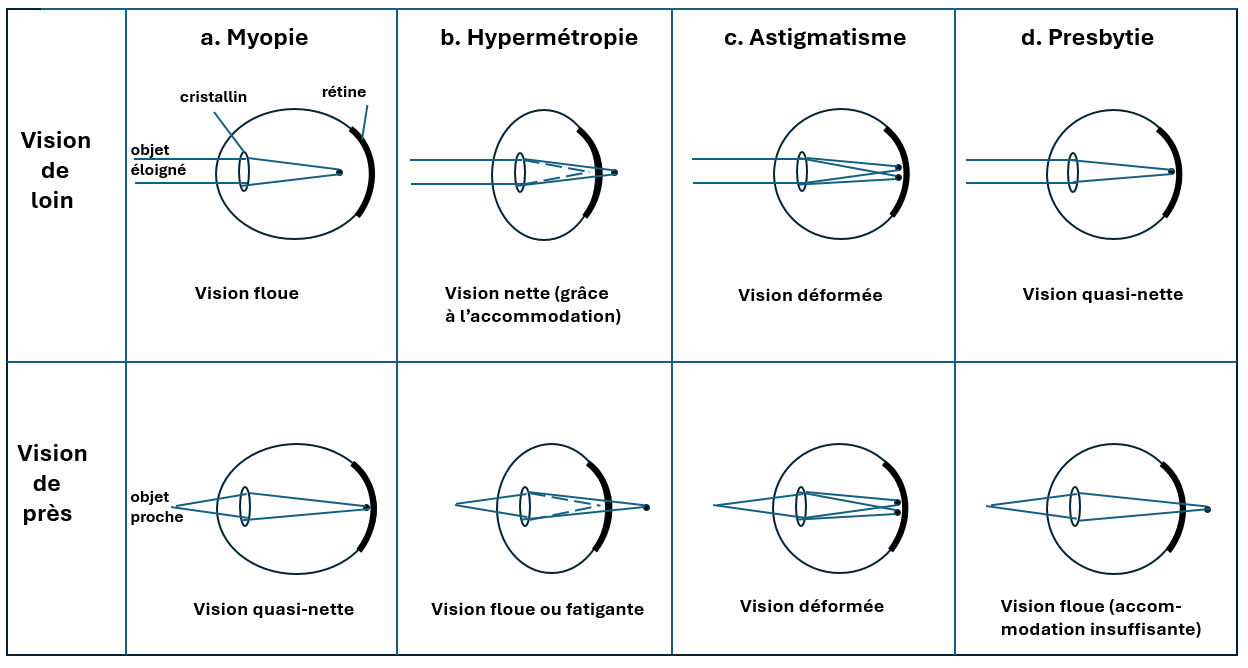
The main visual disorders are the following [PER][CLA][CHA] (see Figure 2 above) :
Myopia (see Figure 2a above) :
Myopia is the most common refractive error. Myopic people have blurred distance vision and fairly clear near vision. Images of distant objects are formed in front of the retina because the eyeball is too long, or because the optical system is too powerful (often due to an overly curved cornea or, more rarely, an overly convergent crystalline lens). In distance vision, the crystalline lens is already at rest at its minimum convergence and cannot reduce it further to bring the image back onto the retina.
Myopia is corrected with diverging (concave) lenses, which are thinner at the center and thicker at the edges.
Hyperopia (see Figure 2b above) :
Hyperopia is the opposite of myopia. Hyperopic people have blurred near vision but clear distance vision. Without accommodation, images of distant objects are formed behind the retina because the eyeball is too short, or because the optical system is not powerful enough (often due to an overly flat cornea or, more rarely, an insufficiently convergent crystalline lens).
In young individuals, accommodation of the crystalline lens can often compensate for this defect, particularly for distance vision. However, this accommodative effort, even greater for near vision, may become insufficient with age, resulting in blurred vision or eye strain.
To reduce this visual effort, hyperopia is corrected with converging (convex) lenses, which are thicker at the center and thinner at the edges.
Astigmatism (see Figure 2c above) :
Astigmatism is caused by a cornea (or, more rarely, a crystalline lens) whose surfaces are not perfectly spherical, with different radii of curvature depending on the meridian. Light rays do not converge to a single focal point on the retina but instead focus in different planes, causing blurred or distorted vision at both distance and near.
Accommodation of the crystalline lens cannot correct this defect.
Astigmatism is corrected with toric or cylindrical lenses, which compensate for the differences in corneal curvature along two perpendicular axes.
Presbyopia (see Figure 2d above) :
People with presbyopia have blurred near vision and fairly clear distance vision. With age, the crystalline lens gradually loses its flexibility, making accommodation more difficult.
Images of a near object form behind the retina and can no longer be sufficiently brought back onto it by accommodation of the crystalline lens.
In a young adult, the crystalline lens can increase the eye's optical power by approximately 10 diopters through accommodation, allowing clear vision of very close objects. By around 40 to 45 years of age, accommodation is reduced to approximately 5 diopters, and it continues to decline until it becomes almost negligible by the age of 60.
Presbyopia is corrected with converging lenses, as in the case of hyperopia.
E7.3. Optical prescription :
An optical prescription describes the right eye (OD) first and then the left eye (OS), for distance vision (DV) and near vision (NV), according to three distinct components [PER][CLA][CHA] :
1. Sphere (Sph). The sphere represents the spherical power of the corrective lens, expressed in diopters. It is negative for the correction of myopia and positive for the correction of hyperopia. In the case of presbyopia, the near-vision correction is generally specified separately as a positive addition (Add).
2. Cylinder (Cyl) and Axis. These values represent the correction of astigmatism.
- A meridian is the section of the cornea (or crystalline lens) by a plane passing through the optical axis of the eye. Its orientation is specified by an angle between 0° and 180°, measured from the horizontal in a counterclockwise direction when the eye is viewed from the front.
- The cylinder (in diopters) indicates the difference in power between two perpendicular meridians of the eye. It may be written in negative-cylinder notation (the most common notation used by opticians) or in positive-cylinder notation (less common and sometimes used by ophthalmologists).
- The axis indicates the orientation of the meridian associated with the spherical power specified in the prescription (reference meridian). In positive cylinder notation, this is the meridian of minimum power. In negative cylinder notation, it is the meridian of maximum power. The cylindrical correction is applied in the perpendicular meridian. An axis of 90° is vertical.
Example in positive cylinder notation :
OD : +1.75 (+0.50) 30°
This prescription gives the two principal powers : +1.75 at 30° (reference meridian) and +2.25 at 120° (perpendicular meridian, which receives the cylindrical correction).
The same prescription in negative-cylinder notation is OD : +2.25 (-0.50) 120°
Warning : Depending on the software or prescription format, the closing parenthesis may be placed after the axis without changing the meaning. Thus, OD : +1.75 (+0.50 30°) is strictly equivalent to OD : +1.75 (+0.50) 30° and does not indicate a power of +2.25 D at 30°.
3. Addition (Add). The addition represents the extra power (in diopters) added for near vision (reading, computer screens, approximately 40 cm), relative to distance vision.
It is always positive and typically ranges from +0.75 D to +3.00 D depending on age and visual requirements.
The prescription is sometimes followed by the pupillary distance (PD), expressed in millimeters, in order to position the lenses correctly in front of the pupils. This distance may be specified :
- Globally : a single value for both eyes (example : 68 mm).
- Monocularly : two values, one for each eye, such that OD + OS equals the total PD (example : OD = 35 mm, OS = 33 mm).
E7.4. Vision corrective methods :
Depending on the visual disorder and the patient's age, vision can be corrected with eyeglasses, contact lenses, or refractive surgery [PER][CLA][CHA].
1. Eyeglasses :
Eyeglasses may be fitted with single-vision lenses (one focal distance only) or progressive lenses (distance and near vision correction combined in the same lens).
- Advantages : Barrier against dust, UV rays, and projectiles, minimal maintenance, flexibility of use.
- Contraindications : Significant anisometropia (difference in prescription greater than 3 or 4 diopters between the two eyes, which may induce an uncomfortable difference in image size), certain professions or sporting activities in which wearing glasses is impractical or hazardous.
- Risks : Very rare, mild, and reversible risks (headaches, eye strain, or visual discomfort in case of an unsuitable prescription or poor lens centering).
The power of a corrective lens is expressed in diopters (D). The greater its absolute value, the stronger the optical correction : a -0.50 D lens corrects mild myopia, while a -8.00 D lens corrects severe myopia.
2. Contact lenses :
Contact lenses are corrective lenses worn directly on the cornea. They can be soft (the most common) or rigid (mainly indicated in cases of irregular astigmatism or keratoconus). They are available in spherical, toric (astigmatism), or multifocal (presbyopia) versions.
- Advantages : Complete field of vision (no frame borders), total discretion, comfort for sports, possible correction of severe anisometropia.
- Contraindications : Severe dry eye, chronic ocular allergies or infections, poor hygiene or difficulty handling contact lenses properly, dusty environments or exposure to chemical products.
- Risks : Occasional, sometimes serious but reversible risks (corneal infections such as abscesses or ulcers, mainly linked to poor hygiene or overnight wear).
3. Refractive surgery :
Refractive surgery encompasses several techniques :
- Corneal surgery, the most common, consists in reshaping the curvature of the cornea by tissue ablation using an excimer laser, according to two possible approaches : LASIK (cutting a superficial corneal flap, laser ablation under the flap, then repositioning of the flap) and PRK (laser ablation directly on the surface, without cutting a flap).
- Intraocular implants come in two approaches, without touching the cornea : phakic lens (additive lens implanted in front of the crystalline lens) and crystalline lens replacement (crystalline lens replaced by a fixed-power implant using a technique similar to cataract surgery).
In both cases :
- Advantages : Long-lasting and precise results, total freedom (sports, swimming, various activities).
- Contraindications (corneal surgery) : Cornea that is too thin, keratoconus (a progressive deformation of the cornea) or another progressive corneal disease, unstable refractive error (particularly myopia or hyperopia), severe dry eye, certain medical conditions that may impair healing.
- Risks (corneal surgery) : Rare, sometimes serious, and sometimes irreversible risks (healing complications, chronic dry eye, chronic halos and glare).
E7.5. Sources relating to visual disorders :
[CHA] ChatGPT, le moteur d'Intelligence Artificielle développé par OpenAI.
[CLA] Claude, le moteur d'Intelligence Artificielle développé par Anthropic.
[PER] Perplexity, le moteur d'Intelligence Artificielle développé par Perplexity AI.

E8.1. Introduction [PER][CHA] :
Tattooing is a practice that consists of introducing pigments permanently into the dermis, the deep layer of the skin, using needles. The design becomes visible through the epidermis once healing is complete. This permanent body modification is most often chosen for aesthetic, symbolic, or cultural reasons.
From a biological standpoint, tattooing is an invasive procedure. However, the foreign substances implanted in the skin are generally tolerated by the body, much like a dental implant or a prosthesis.
Health surveillance data indicate that about 95 % of tattoos cause no complications, 5 % lead to manageable complications, and less than 1 % require long, complex treatment, sometimes including surgery.
Warning :
- Socially, a very visible tattoo, such as on the hands, neck, or face, may limit certain professional or social opportunities.
- Psychologically, a tattoo should remain acceptable despite personal changes, such as shifts in taste, relationship breakups, or aging.
- Practically, during the healing phase, a fresh tattoo must be protected from sunlight, prolonged bathing, scratching, and friction.
In France, public information requirements, hygiene rules applicable to professionals, and the monitoring of adverse effects are governed by the Public Health Code.
The decree of March 5, 2024 specifies the official training, certification, and hygiene requirements for practicing tattooing, permanent makeup, and body piercing.
"Tattoo vigilance" the system designed to collect and analyze reports of adverse effects, is overseen by ANSM, the French National Agency for Medicines and Health Products Safety.
E8.2. Medical contraindications :
There are very few absolute contraindications to tattooing. However, several so-called "relative" contraindications require prior medical advice. These include :
- Chronic skin conditions, such as psoriasis, eczema, vitiligo, or lichen planus.
- A particular tendency toward scarring, with a history of keloid scars (raised scars), or very reactive or inflamed skin.
- An allergic tendency, especially in cases of allergy to metals, dyes, or cosmetics.
- Autoimmune diseases or immunodeficiency, such as lupus, rheumatoid arthritis, inflammatory bowel disease, or well-controlled HIV.
- Treatments that affect healing, immunity, or bleeding, such as anticoagulants, antiplatelet drugs, or long-term corticosteroids.
- Controlled chronic conditions such as diabetes or significant venous insufficiency in the area to be tattooed.
- Pregnancy and breastfeeding, as a precaution.
E8.3. Tattoo removal :
Tattoo removal aims to reduce the visibility of a tattoo or make it disappear, most often by laser, by breaking up the pigments in the skin. It never restores the skin or the body to their original state.
Tattoo removal is generally much more expensive than the initial tattoo, time-consuming, requiring many sessions spaced over several months, painful at each session, and the result remains variable.
Black is the easiest color to remove. Color mixtures and very dense inks make the process much more difficult.
E8.4. Main points to check before getting a tattoo :
The choice of tattoo artist is essential. The main points to check before getting a tattoo are as follows :
- For individuals who do not belong to a healthcare profession, practicing tattooing requires obtaining the mandatory certificate of "Training in hygiene and sanitation conditions for tattooing, body piercing, and permanent makeup practices". This training is provided by accredited organisations, in accordance with the French Public Health Code and the decree of 5 March 2024. It leads to certification issued under the supervision of the ARS (Regional Health Agency), valid for 5 years, after which the training must be renewed.
- No commercial pressure or encouragement to make a quick decision.
- Clear information about contraindications, risks, and healing/cicatrisation.
- Use of identified, compliant, and traceable inks.
- Prior questions regarding allergies, medical treatments, or skin conditions.
- Clean, organised studio with visible hygiene standards.
- Wearing single-use disposable gloves, changed between each client and after any contact with a non-sterile object (telephone, door handle, computer keyboard, etc.).
- Use of sterile or single-use equipment for any item in contact with the skin, blood, ink, or working area.
- Opening of needles and main consumables in front of the client.
E8.5. Sources relating to tattooing :
[CHA] ChatGPT, le moteur d'Intelligence Artificielle développé par OpenAI.
[PER] Perplexity, le moteur d'Intelligence Artificielle développé par Perplexity AI.
 Last page update : August 22, 2026.